
Https Drivegooglecom File D 1xy8bpgzdxewx5wtnbtwxvj9mvynojl K View — Usp Sharing Work
State of the art timing analysis
with industry-hardened methods and tools.
State of the art timing analysis
with industry-hardened methods and tools.
...with industry-hardened methods and tools. T1 empowers and enables. T1 is the most frequently deployed timing tool in the automotive industry , being used for many years in hundreds of mass-production projects.
As a worldwide premiere, the ISO 26262 ASIL‑D certified T1-TARGET-SW allows safe instrumentation based timing analysis and timing supervision. In the car. In mass-production.
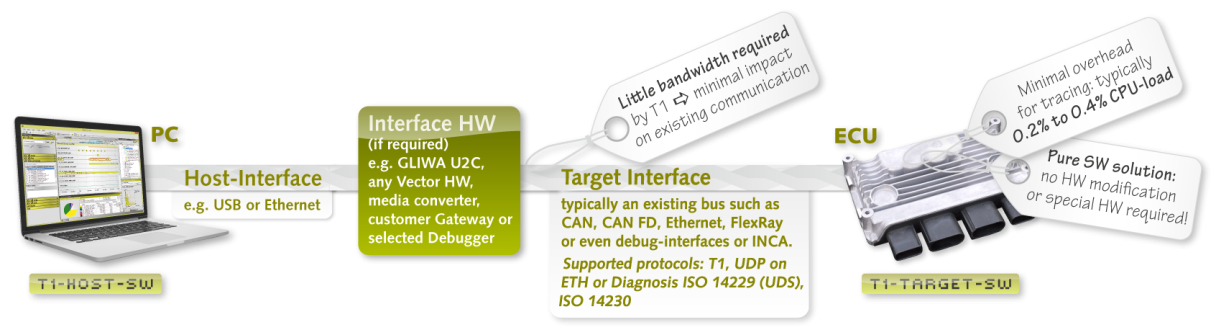
T1.timing comes with two extension options. Add-on product T1.streaming provides the possibility to stream trace data continuously — over seconds, minutes, hours or even days. Add-on product T1.posix supports POSIX operating systems such as Linux or QNX.
T1.timing comes with a modular concept and several plug-ins which are described in the following. Plug-ins can be easily enabled or disabled at compile-time using dedicated compiler switches such as T1_DISABLE_T1_CONT. To disable T1 altogether, it is sufficient to disable compiler switch T1_ENABLE which leaves the system in a state as of before the T1 integration.
Direct access to private external links like Google Drive is not supported due to security protocols. To receive a review, paste the file's text directly into the chat. For detailed information on sharing and managing file permissions, visit Google Drive Help Google Help View & open files - Google Drive Help
Restricted Google Drive links generally require the owner to grant explicit access or set file visibility to "Anyone with the link". To resolve access issues, ensure you are signed into the correct account or use the "Request Access" button to contact the owner. For troubleshooting steps and to manage sharing settings, visit the Google Drive Help Center Google Help View & open files - Google Drive Help
It looks like the string you provided is not a standard search keyword, but rather a Google Drive file link (specifically, a URL pointing to a file with ID 1xy8bpgzdxewx5wtnbtwxvj9mvynojl_k ). If you intend for me to write a long article about that specific file or its contents, I cannot access external links or view private/shared files. However, I can do the following:
Option 1: Write a general article about how to work with shared Google Drive links (using your link as an example) Here is a long-form article based on the pattern of your link:
Mastering Google Drive Shared Links: A Complete Guide to Accessing, Managing, and Collaborating (Case Study: drive.google.com/file/d/[ID]/view ) Introduction Google Drive has become the backbone of modern digital collaboration. Every day, millions of users share files using links that look like this: https://drive.google.com/file/d/1xy8bpgzdxewx5wtnbtwxvj9mvynojl_k/view?usp=sharing If you’ve received such a link, you might wonder: What is this file? How do I open it? Can I edit it? What if it says “Access Denied”? This comprehensive guide will walk you through everything you need to know—using the format of your specific link as a real-world example. Anatomy of a Google Drive Shared Link Let’s break down the structure: | Part | Example | Meaning | |------|---------|---------| | Base URL | https://drive.google.com/file/d/ | Google Drive file viewer endpoint | | File ID | 1xy8bpgzdxewx5wtnbtwxvj9mvynojl_k | Unique identifier for the file | | /view | /view | Instructs Google to open the preview mode | | Query param | ?usp=sharing | “Sharing” source tracking (often added automatically) | The file ID is the most critical part. Without proper permissions, even the correct ID will not grant access. Step 1: How to Open the Link Correctly
Copy the entire link – Ensure no spaces or line breaks. Paste into any modern browser (Chrome, Firefox, Safari, Edge). If prompted, log in to your Google account – Some files require authentication. Request access if the owner has restricted sharing.
⚠️ Common error: If you see “Access Denied” or “You need permission,” the file owner has not shared it with you directly or via a public link.
Step 2: What to Do When You Can’t Access the File Your link ( ...1xy8bpgzdxewx5wtnbtwxvj9mvynojl_k... ) may point to a private file. Here’s your troubleshooting checklist:
Contact the sender – Ask them to share the file with your exact email address. Check for typos – Google Drive file IDs are case‑sensitive and contain letters, numbers, underscores, and hyphens. Try incognito mode – If you have multiple Google accounts, Drive may be checking the wrong one. Log out and back in – Refreshes permission tokens.
Step 3: How to Work With the File Once Opened Assuming you gain access, here’s what you can do: Viewing
Google Drive supports preview for: PDFs, images, videos, text files, Microsoft Office, and Google Docs/Sheets/Slides.
Downloading
For POSIX-based projects, see T1.posix.
Direct access to private external links like Google Drive is not supported due to security protocols. To receive a review, paste the file's text directly into the chat. For detailed information on sharing and managing file permissions, visit Google Drive Help Google Help View & open files - Google Drive Help
Restricted Google Drive links generally require the owner to grant explicit access or set file visibility to "Anyone with the link". To resolve access issues, ensure you are signed into the correct account or use the "Request Access" button to contact the owner. For troubleshooting steps and to manage sharing settings, visit the Google Drive Help Center Google Help View & open files - Google Drive Help
It looks like the string you provided is not a standard search keyword, but rather a Google Drive file link (specifically, a URL pointing to a file with ID 1xy8bpgzdxewx5wtnbtwxvj9mvynojl_k ). If you intend for me to write a long article about that specific file or its contents, I cannot access external links or view private/shared files. However, I can do the following:
Option 1: Write a general article about how to work with shared Google Drive links (using your link as an example) Here is a long-form article based on the pattern of your link: Direct access to private external links like Google
Mastering Google Drive Shared Links: A Complete Guide to Accessing, Managing, and Collaborating (Case Study: drive.google.com/file/d/[ID]/view ) Introduction Google Drive has become the backbone of modern digital collaboration. Every day, millions of users share files using links that look like this: https://drive.google.com/file/d/1xy8bpgzdxewx5wtnbtwxvj9mvynojl_k/view?usp=sharing If you’ve received such a link, you might wonder: What is this file? How do I open it? Can I edit it? What if it says “Access Denied”? This comprehensive guide will walk you through everything you need to know—using the format of your specific link as a real-world example. Anatomy of a Google Drive Shared Link Let’s break down the structure: | Part | Example | Meaning | |------|---------|---------| | Base URL | https://drive.google.com/file/d/ | Google Drive file viewer endpoint | | File ID | 1xy8bpgzdxewx5wtnbtwxvj9mvynojl_k | Unique identifier for the file | | /view | /view | Instructs Google to open the preview mode | | Query param | ?usp=sharing | “Sharing” source tracking (often added automatically) | The file ID is the most critical part. Without proper permissions, even the correct ID will not grant access. Step 1: How to Open the Link Correctly
Copy the entire link – Ensure no spaces or line breaks. Paste into any modern browser (Chrome, Firefox, Safari, Edge). If prompted, log in to your Google account – Some files require authentication. Request access if the owner has restricted sharing.
⚠️ Common error: If you see “Access Denied” or “You need permission,” the file owner has not shared it with you directly or via a public link. To resolve access issues, ensure you are signed
Step 2: What to Do When You Can’t Access the File Your link ( ...1xy8bpgzdxewx5wtnbtwxvj9mvynojl_k... ) may point to a private file. Here’s your troubleshooting checklist:
Contact the sender – Ask them to share the file with your exact email address. Check for typos – Google Drive file IDs are case‑sensitive and contain letters, numbers, underscores, and hyphens. Try incognito mode – If you have multiple Google accounts, Drive may be checking the wrong one. Log out and back in – Refreshes permission tokens.
Step 3: How to Work With the File Once Opened Assuming you gain access, here’s what you can do: Viewing However, I can do the following: Option 1:
Google Drive supports preview for: PDFs, images, videos, text files, Microsoft Office, and Google Docs/Sheets/Slides.
Downloading
| Vendor | Operating System |
|---|---|
| Customer | Any in-house OS** |
| Customer | No OS - scheduling loop plus interrupts** |
| Elektrobit | EB tresos AutoCore OS |
| Elektrobit | EB tresos Safety OS |
| ETAS | RTA-OS |
| GLIWA | gliwOS |
| HighTec | PXROS-HR |
| Hyundai AutoEver | Mobilgene |
| KPIT Cummins | KPIT** |
| Siemens | Capital VSTAR OS |
| Micriμm | μC/OS-II** |
| Vector | MICROSAR-OS |
| Amazon Web Services | FreeRTOS** |
| WITTENSTEIN high integrity systems | SafeRTOS** |
| Qorix | Qorix Classic |
| Embedded Office | Flexible Safety RTOS |
(**) T1 OS adaptation package T1-ADAPT-OS required.
| Target Interface | Comment |
|---|---|
| CAN | Low bandwidth requirement: typically one CAN message every 1 to 10ms. The bandwidth consumed by T1 is scalable and strictly deterministic. |
| CAN FD | Low bandwidth requirement: typically one CAN message every 1 to 10ms. The bandwidth consumed by T1 is scalable and strictly deterministic. |
| Diagnostic Interface | The diagnostic interface supports ISO14229 (UDS) as well as ISO14230, both via CAN with transportation protocol ISO15765-2 (addressing modes 'normal' and 'extended'). The T1-HOST-SW connects to the Diagnostic Interface using CAN. |
| Ethernet (IP:TCP, UDP) | TCP and UDP can be used, IP-address and port can be configured. |
| FlexRay | FlexRay is supported via the diagnostic interface and a CAN bridge. |
| Serial Line | Serial communication (e.g. RS232) is often used if no other communication interfaces are present. On the PC side, an USB-to-serial adapter is necessary. |
| JTAG/DAP | Interfaces exist to well-known debug environments such as Lauterbach TRACE32, iSYSTEM winIDEA and PLS UDE. The T1 JTAG interface requires an external debugger to be connected and, for data transfer, the target is halted. TriCore processors use DAP instead of JTAG. |
